2016 Redux: Proportional Representation
If there is one thing from the NDP platform that surviving NDP Members of Parliament should push for, it is a legitimate process to design a proportional representation system fit for Canada.

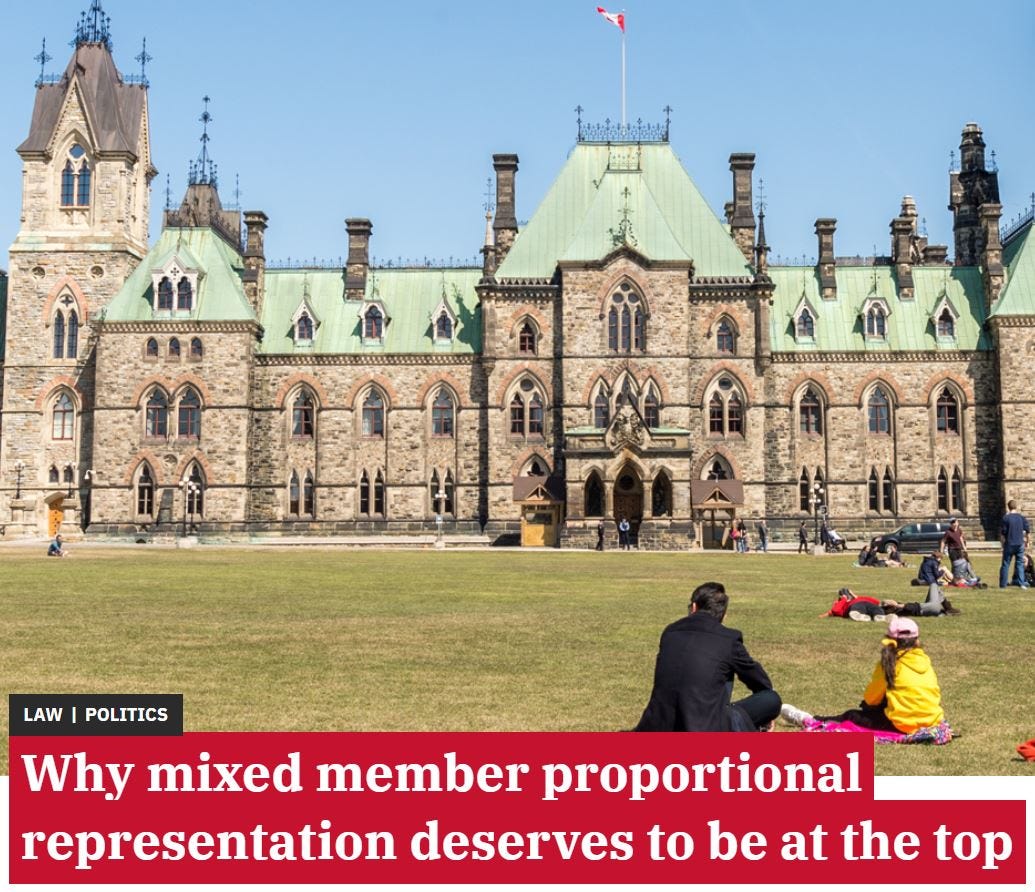
Image as screen grab from 2016 Policy Options article by the author, referenced in the post.
Prologue: I am reproducing an untitled note that I uploaded six days ago, ahead of election day, in response to and building on a post by Ethan Phillips; I have changed it only to fix several typos, to separate into more paragraphs for better flow, to insert the occasional clarifying words in brackets, and — in the interests of humility and recognizing my own biases — to emphasize calculated political deception as being what happened in 2015/16 in preference to my tendency to speak in harsher terms of deliberate lies having occurred.
This post is hopefully a worthwhile transformation (from note to post) given that electoral reform has appeared in the aftermath of the election as an issue; indeed, CBC devoted its online site to a series of articles on it yesterday with this lead article — Kevin Maimann, “Trudeau wanted ranked ballots. Would that have changed Monday's results? Political scientists weigh in on what 2025 election could have looked like” (April 30). Also, today, I see this CBC piece reporting on the Green Party returning to the 2016 process that I describe below: Olivia Stefanovich, “Sole Green MP Elizabeth May looks to play pivotal role in minority Parliament: Green Party leader says results would've been different if Canadians didn't feel weight of strategic voting” (May 1).
~ ~ ~
In late 2014, all NDP MPs and the majority of Liberal MPs (defying the views of their new leader, Justin Trudeau) voted in favour of a motion that I [as Member of Parliament and Official Opposition Critic for Democratic and Parliamentary Reform] tabled in support of the Mixed Member Proportional Representation (MMP) electoral system that Ethan Phillips is calling for [in his Substack post, “Yes, strategic voting is important in this election but it shouldn't be” (April 25)].* Later that year, as the NDP had pulled well ahead [in the polls], not just of the Liberals but closing in on the Harper Conservatives to form government in the upcoming election. At that point - late spring, early summer - Justin made his (in)famous promise that the 2015 election would be the last under the current system.
He used wording [like “make every vote count”] that was deliberately intended to fool some voters that he meant proportional representation (the only serious alternative that had been under discussion for three years under both NDP and Fair Vote Canada nation-wide educational campaigns) and otherwise to fool people into thinking the Liberals were open to proportional representation (PR). Under Trudeau, they never were as, in his head, the only system he wanted to replace the current system with was a single-riding ‘Alternative Vote’ (AV) system that is the antithesis of counting everyone’s first choice as the basis for deciding the percentage of party seats in Parliament: AV is structurally designed to give even larger majorities than the current system to a party like the Liberals that act like chameleons to maximize how many voters see them as second choice.
Trudeau engaged in calculated political decetion. And he carried the deceitforward by killing a parliamentary committee process after the 2015 election that showed the only serious contender for a replacement system is the MMP system (or some version of it) that Ethan Phillips describes. They went so far as to force Liberal committee members to pretend that the committee process led to AV as the best choice. In the end, Trudeau knew he could not force AV through as virtually no one supported it apart from him and a band of instrumentally-thinking Liberal back-roomers.**
Fast forward to fall 2024 and Trudeau told his colleague Nate Erskine Smith, a supporter of PR, [on a widely distributed podcast] that he had one regret after all these years — and that was to have not pushed ahead to legislate AV. His regret was not that he had lied to make the Liberals look like they were open to PR as part of trying to steal momentum from the NDP, but that he had not perfected the deception, as it were, by forcing through the system that he would then have claimed was what he meant all along.
Fast forward again. Out electoral system is operating just as Ethan Phillips describes and a party that was at 16-17% four months ago [the Liberal Party of Canada] is now in the low 40s as many NDP and other voters decide that they have no choice but to vote for the familiar establishment party that is not the Conservatives. It will be a mark of collective will to try to prevent a bad result (a Poilievre-led government) by something like 15-20% of the non-Conservative electorate voting against a party through the only way they think is possible because of the electoral system — that is, voting for their second or even third choice in their riding.
Neither the data available to people, nor the attention people can afford to spend on the actual shape of the riding in which they are voting, nor the media’s narrative of election choices permits more than a small percentage to realize which ridings are Liberal versus NDP contests (or versus Green, for other example) with no hope of a Conservative winning and thus where they should have the freedom to vote their conscience and preference for their preferred party — whether NDP or Liberal. Far less is the average voter clued into knowing the ridings where it is traditionally an NDP versus Conservative battle and thus to realize that voting Liberal (even when they would prefer to vote NDP) risks creating Conservatives coming up the middle in three way races in those ridings. And so on.
My point is that we have a system that is anti-democratic not only in not being designed to have every first-preference vote count but also in being based on information-flow gaps that cause voting distortion once voters decide they are willing to vote ‘strategically.’
The NDP platform again calls for MMP to be legislated.*** If the Libs form a minority govt, the NDP should put this at or near the top of the list in negotiations to form a government of national unity.
FOOTNOTES:
* For a brief overview of the advantages of the MMP system, the proportional representation system used in New Zealand and Germany, see this piece published in 2016 in Policy Options, being a reproduction of my September 1, 2025, testimony before the parliamentary committee considering the Liberal campaign promise to replace our first-past-the-post system: Craig Scott, “Why mixed member proportional representation deserves to be at the top: Mixed member proportional is the ideal system, but principled and respectful compromise can do the job too” (September 23, 2016). At the start, it describes the motion and the vote by 16 of the Liberals’ 31 MPs for it.
** It had been clear to me during the summer/fall 2015 election that the Trudeau promise was a phony one, so clear that one of the NDP’s biggest campaigning mistakes was its decision not to have me, or leader Tom Mulcair, alert voters that Trudeau himself did not believe in proportional representation and was deceitfully masking that fact. Following my loss of my seat, along with all NDPers in Toronto, I was confident enough in my analysis of Trudeau and the Liberals to (accurately) predict the game they would play on electoral reform in a debriefing exit interview on CBC with Terry Milewski in late fall 2015, the content of which the CBC then turned into this article: John Paul Tasker, “Liberal changes to electoral system 'set up to fail,' says defeated NDP MP Craig Scott — 'I honestly do not believe that there is a commitment to proportional representation,' outgoing MP says” (October 28, 205).
After three months of the parliamentary committee process in fall 2016, it was painfully obvious that the Liberal’s end game would be as I predicted— and roughly clear how they would wiggle out of any committee consensus. That committee consensus came out in the final committee report: all four other parties in the House — NDP, Conservatives, Greens and the Bloc — voted for a referendum on proportional representation, with the NDP and Greens adding their view that there was a mandate to adopt legislation and then worry about a referendum down the road once people had experience with the new system and could compare what they knew from before to what they had newly experienced (the two-step approach New Zealand took). When the report came out, I wrote again in Policy Options to explain to Canadians the “noble failure” spin the Liberals were rolling out in order to reject the committee report and then to ditch the Trudeau ‘promise’ entirely: Craig Scott, “The ‘noble failure’ approach to electoral reform: All five Liberals on the electoral reform committee were focused on a result that will lead to zero electoral reform” (December 6, 2016).
*** The section from Pillar 8 of NDP election commitments:
Putting an end to unfair elections
We will fix Canada’s broken voting system and make every vote count. For too long, our electoral system has distorted results and denied millions of Canadians real representation. In 2025, New Democrats will make sure it’s the last election held under this outdated, unfair system—ten years after the Liberals promised change and failed to act.
Unlike the Liberals, we will actually deliver. We will establish an independent citizens assembly to advise on how best to put in place a Mixed-Member proportional system in time for the next federal election. This will ensure that the next Parliament truly reflects the choices of voters.